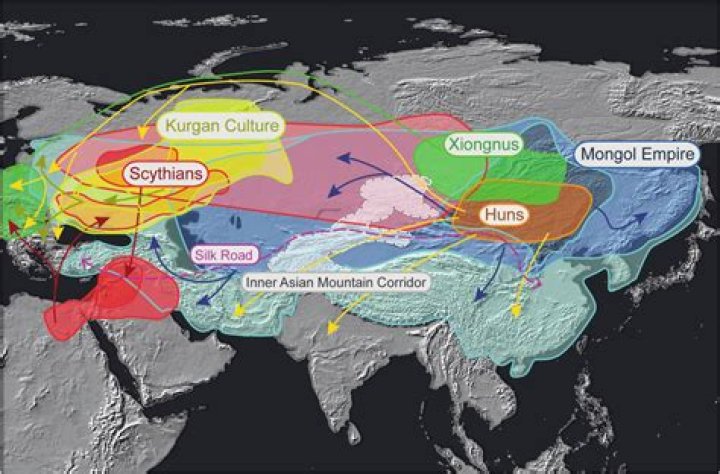
The Xiongnu were fierce mounted warriors who were able to muster as many as 300,000 horseback archers on their periodic intrusions into North China, and they were more than a match for the much less-maneuverable chariots of the Chinese.
Who are the descendants of the Xiongnu?
Although the Xiongnu’s power waned, their descendants, the Huns, rose a few centuries later to wreak havoc in Europe, Persia, and India. An important impact of the Xiongnu was the construction of the Great Wall of China.
Who were the Huns and Xiongnu?
The Xiongnu were a group of barbarians who caused 1st century China considerable problems until finally they were defeated and expelled. Three centuries later a group of savages,the Huns,invaded the steppes taking on all comers starting with the Alani and moving on to the Goths whom they defeated in 370 CE.
Are the Huns related to the Xiongnu?
The Huns were Turkic in the sense that they originated in the Ural Mountains. It is unlikely the Huns are related to the Xiongnu, who were a Mongolian people. Theories have been made that the Huns, who came later than the Xiongnu, were descended from Xiongnu migrants, but this is pure speculation.
Who were the Xiongnu quizlet?
Xiongnu is the Chinese name for the confederacy of Turkish-speaking peoples who were nomadic herders of horses, sheep, and camels in Central Asia. The Han dynasty’s tribute payments of silk to the Xiongnu caused some of the empire’s financial weakness.
Where are the Xiongnu from?
The Xiongnu were based in what is now Mongolia and frequently raided south into China. They were such a threat that the first Qin Dynasty emperor, Qin Shi Huang, ordered the construction of huge fortifications along the northern border of China—fortifications that later were expanded into the Great Wall of China.
Are the Xiongnu Mongols?
Xiongnu. According to a number of sources, one of the ancestors of the Mongols were the Xiongnu, although it is not yet known whether they were proto-Mongols. The Xiongnu were a group of nomads who dominated the Asian steppe from the late 3rd century BC for more than 500 years.
What did the Xiongnu speak?
The “traditional and prevailing view is [] that the Xiongnu and/or the Huns were Turkic” speakers. Otto Maenchen-Helfen argues that many tribal and proper names among the Huns appear to have originated in Turkic languages, indicating that the language was Turkic.
What did the Xiongnu look like?
Mid: Xiongnu figure from Xian History Museum 2. Right: Sculpture representing mounted nomade – from Anpu and his wife’s tomb in Longmen Luoyang – found 1981 – Tang dynasty. They have large round heads, often barrel-shaped bodies, sometimes a potbelly, and most often a full beard from one ear to another.
Are the Xiongnu Turkic?
Xiongnu were Turkic and related to Di (Tiele) people of Northern China. Their neighbor, the Donghu (Eastern Hu. Xiongnu were probably Central Hu) tribe were the Mongols. Later, the Dong-Hu tribe founded the Xianbei Empire.
Are Huns and Mongols the same?
Ethnically, the original Huns are the same as Mongol. However, the Huns were very liberal and when they settled in Europe, they took wives of non-Asian ethnicity and then their children became mixed. So Huns became more European over time, but the original Huns were Asian, just like the Mongols.
Is Attila the Hun Hungarian?
Born in Pannonia, a province of the Roman Empire (present-day Transdanubia, Hungary), circa 406, Attila the Hun and his brother, Bleda, were named co-rulers of the Huns in 434. Upon murdering his brother in 445, Attila became the 5th-century king of the Hunnic Empire and the sole ruler of the Huns.
Where are the Xiongnu now?
After their previous rivals, the Yuezhi, migrated into Central Asia during the 2nd century BC, the Xiongnu became a dominant power on the steppes of East Asia, centred on an area known later as Mongolia. The Xiongnu were also active in areas now part of Siberia, Inner Mongolia, Gansu and Xinjiang.
Are Huns and Magyars the same?
Both the Huns and the Magyars were of Asian origin ; the Hunnish language appears to have been Turkic but Magyar is a Finno-Ugrian language which was strongly influenced by Turkic languages .
How did the Han defeat the Xiongnu?
Due to the series of victories, the Han had conquered a territory stretching from the Hexi Corridor to Lop Nur, thus cutting the Xiongnu off from their Qiang allies. In 111 BC, a major Qiang–Xiongnu allied force was repelled from the Hexi Corridor.
What is griot AP world history?
Griot. A professional singer or storyteller that transmitted stories, histories, epics, and other accounts.
What was the almoravid Empire quizlet?
Almoravid Empire. Definition: Islamic religious movement in Africa, sparked by Ibn Yasin after returning from a pilgrimage to Mecca. Significance: Occupied much of NorthWest Africa and Southern Spain where it had considerable prosperity with the golden trade. (Formed from expansions and spread of Islam).
What is Swahili AP world history?
Swahili. Bantu-speaking people of the East African coast, living in towns and villages; a Muslim and maritime people; also their language (more properly Kiswahili) which has many Arabic loanwords; Swahili is now the official language of Kenya and Tanzania.